
Innovation Reference Architecture: A Framework for Enterprise Innovation
Published March 19, 2018
Abstract
Innovation is a concept that most organizations aspire towards, but haven’t formally embraced. The rewards can be immense, but most organizations have no clear path towards innovating. This report is designed to give organizations a model for systematizing innovation leveraging TechVision’s innovation reference architecture.
We start with the premise that innovation shouldn’t be a one-time program; it is a continuous process that becomes a source of competitive advantage in a rapidly changing market. Innovation should be a business function just like accounting, marketing, or operations. And as such, innovation requires a distinct set of tools, processes, and skills that are different from the management of an existing business. We can’t expect serious innovation results if we don’t give people who we ask to innovate sufficient skills, resources, time and space. In this report, TechVision Research introduces a reference architecture for innovation to help enterprises organize their innovation efforts into a continuous, sustainable process.
TechVision has defined this reference architecture to help our clients better organize and manage their continuous innovation process. This reference architecture is not meant to be prescriptive in that each organization must develop their innovation capabilities according to their own strategy. That said, we do offer recommendations and a framework for your consideration.
This report covers
- The innovation spectrum; the timeframes and types of innovation efforts
- Strategy and capabilities; the fundamental starting point for innovation
- Methods and processes; the necessary components for a viable continuous innovation process
- People and networks: the human side of innovation
- Execution guidance including specific tools to use in an innovation program.
Author:
Gary Zimmerman
CMO & Principal Consulting Analyst
Executive Summary
The vast majority of executives understand that innovation is a critical success factor for continued success. The idea of betting the future on a sustainable competitive advantage in an information economy is becoming more and more speculative and the only way to stay ahead is to capitalize on good ideas before the competition does. The challenge is that while most businesses do not lack good ideas, they lack the ability to commercialize their ideas.
Innovation is much more than coming up with great ideas. In fact, it is more about delivery, people, and process. The proper processes, mechanisms, and organizational structures need to be in place for innovation to be successful. This includes having the right incentives in place to reward for employees, and establishing an open environment with the right teams and tools for success. Innovation is supported by effective collaboration and decision-making throughout an ideas lifecycle as it progresses from elaboration, selection, execution, and delivery of targeted benefits.
In this report, TechVision Research is introducing an Innovation Reference Architecture which describes a framework for the entire Innovation System, including:
- The scope of the innovation efforts covering everything from continuous improvement to game-changing initiatives which is further described in the Innovation Spectrum section.
- The springboard of enterprise innovation efforts, current enterprise resources and intellectual capital which is expanded upon in the Strategy and Capabilities section.
- A recommended business process for innovation itself as described in the Methods and Processes section.
- The human capital involved in innovating both within and external to the enterprise are described in the People and Networks section.
- Some recommended techniques used to execute the innovation program are highlighted in the Execution section.
- The technology platforms that will most likely influence innovation efforts are described in the Digital Platform section.
- And finally, the overall management of the innovation system itself is laid out in Coordination and Governance section.
We recommend that our clients use it to benchmark their current innovation processes and fill in any gaps they discover in their current efforts. For those that are just forming a formal corporate innovation program, the reference architecture can be the basis for organize the various, sometimes disconnected, innovation efforts currently underway.
By adopting a formal framework for innovation, enterprises can expect the following benefits.
- A focus on efforts that provide strategic benefit. Even a successful innovation effort that is counter to the corporate strategy can be distracting at best, destructive at worst.
- A disciplined approach that produces less waste. From problem identification and brainstorming to development and testing, following a set road-map makes the most of innovation efforts. When the process is clear and repeatable, and makes it possible for an organization to measure their progress and efforts.
- With the measurement system established, the processes are improved, better formed concepts emerge, and competitive advantage and significant return on investment are realized.
In the long term, successful companies should understand that innovation is not a one-off effort; it is a continuous process that becomes a source of competitive advantage in a rapidly changing market. As a continuous process, innovation is a business function just like accounting, marketing, or operations; it requires a distinct set of tools, processes, and skills that are different from the management of an existing business. We can’t expect serious innovation results if we don’t give people who we ask to innovate sufficient skills, resources, time and space.
Introduction
Digital transformation and corporate innovation are two of the biggest trends in business modernization today. Innovation, beyond traditional R&D, is in fact, becoming a corporate mandate within advanced organizations. At the same time, our experience also shows that corporate innovation is nascent and an opportunity for organizations to explore new opportunities internally and externally.
Innovation is more than coming up with great ideas. In fact, it is more about delivery, people, and process. The proper processes, mechanisms, and organizational structures need to be in place for innovation to be successful. This includes having the right incentives in place to reward for employees, and establishing an open environment with the right teams and tools for success. Innovation is supported by effective collaboration and decision-making throughout an ideas lifecycle as it progresses from elaboration, selection, execution, and delivery of targeted benefits.
In this report, TechVision Research introduces a reference architecture for innovation to help enterprises organize their innovation efforts into a continuous, sustainable process.
What is Innovation?
Innovate – in·no·vate / ˈinəˌvāt / verb
Make changes in something established, especially by introducing new methods, ideas, or products. Introduce something new, especially a product.
Innovation is truly a confusing buzzword which many people love to hate. Every business leader agrees that their enterprise needs to be innovative, but nobody can quite seem to agree on what it actually is, what it means, or how to recognize it.
If you ask Google to define innovation, it is less than helpful, coming up with over 300 million results with thousands of definitions. In our report, “Applying Start-up Concepts to Enterprise Innovation,” we even defined innovation as “The making of changes in something established, especially by introducing new methods, ideas, or products; introducing something new, especially a product.” Again, technically accurate but not necessarily useful in designing, developing or implementing an innovation program.
How do we make innovation useful? How do we take something so ephemeral and make it tangible? By looking at it as a system; a set of processes and assets assembled for a specific purpose – to realize the strategic intent of the business.
Innovation Strategy
An organization’s capacity for innovation stems from an innovation system, a coherent set of interdependent processes, organization roles, and supporting platforms that dictates how the company searches for novel problems and solutions, synthesizes ideas into a business concept and product designs, and selects which projects get funded.
But organizations are extremely complex systems. Rigid rules will not address the intricacy present during the innovation process. When the variables are few, control is possible, and rules can apply. But when the variables are many and uncertainty is widespread, an innovation strategy can direct decisions and guide behaviors. A company’s innovation strategy should specify how the different types of innovation fit into the business strategy and the resources that should be allocated to each. TechVision recommends defining an innovation strategy that addresses these questions:
- Why innovate?
- Where should you focus innovation efforts?
- How much innovation is required/desired?
- How can you innovate more effectively?
- With whom should you innovate?
- Who is going to be responsible for what regarding innovation?
There isn’t a single innovation strategy that fits all companies equally well or works under all circumstances. There is nothing wrong, of course, with learning from others, but it is a mistake to believe that what works for Netflix or Google is going to work for your organization. An explicit innovation strategy helps you design a system to match your specific competitive needs. In this report, TechVision provides guidance to help our clients as they work to answer these questions.
Why Innovate?
It used to take years or even decades for disruptive innovations to displace dominant products and destabilize incumbent industries. Today, anybody can wake up in the morning with an idea, design a product online, get bids to manufacture it, crowdsource financing, promote it and arrange shipping in the cloud—all without ever getting up from the breakfast table. That means that any business can be devastated virtually overnight by something better and cheaper.
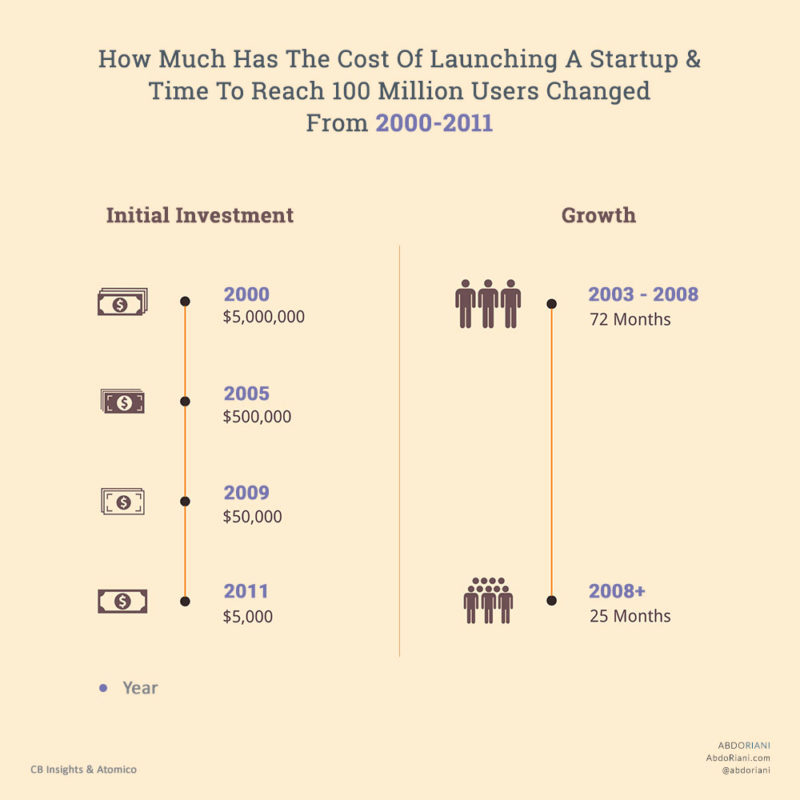
Figure 1 – Business at Internet speed
Thanks to open source software and cloud-based tools, it has never been cheaper to launch a startup according to an estimation by CB Insights. Just as startup initial investment decreased significantly in a little over a decade, so did time to reach 100 million users. According to Atomico, on average, it takes growth startups about 25 months to reach a user base that used to take around 72 months to acquire a decade ago. The irony is that the revolutionary invention of the telephone took 75 years to reach 100 million users when Candy Crush only needed 15 months.
A new player can disrupt almost any market because technology has evened the playing field. Incumbents can no longer rely on market dominance and high barriers to entry as a means of competitive advantage. This also applies to the enterprise in that large organizations can launch internal pilots, prototypes and advanced development efforts faster and at a lower cost.
Enterprise investments in digital transformation are making companies fungible – capable of change. But digital transformation is a double-edged sword. You have to transform in order to be fungible enough to compete and grow in an increasingly unpredictable market, but as you digitize and codify your core business, you also open yourself up to a host of competitors that were previously constrained by high cost of entry and proprietary knowhow.
The implications of digital transformation are moving beyond the original objectives of IT digital transformation efforts. Technology is becoming infused into every aspect of business. Products and production are merging as emerging technologies such as fog computing, Industrial Internet of Things (IIoT), digital manufacturing, and 3D printing move from the lab into the mainstream. Knowledge work is becoming increasingly digitized as well through breakthroughs in advanced analytics and cognitive robotic process automation (RPA). So, whether your business monetizes “making things” or “knowing things,” you have to be able to change and innovate at speed; because you can bet there are competitors out there that are doing just that.
Innovators and the next generation of category leaders are taking advantage of three shifts in the new product development landscape to deliver compelling alternatives to existing offers. They are the declining cost of product/service creation, pervasive information availability and the rapidly declining cost of experimentation/iteration.
The Declining Cost of Product / Service Creation
Clayton Christensen described disruptors as the companies that enter an established market with a lower quality product with fewer features and a lower price. These disruptors attract customers that are no longer attractive to established leaders. Disruptors focus on price and then increase quality and features over time to eventually displace the incumbent market leaders.
However, this concept of disruptive evolution is under pressure. No longer does a new player have to start at the bottom of the value chain. Steep declines in the cost of key raw materials, including computer hardware and software, along with increasingly efficient global supply chains, empowers innovators large and small to compete on all three traditional strategic dimensions at once: products and services can begin life with higher quality, at a lower price, and more easily customized that those of traditional competitors dealing with an installed base and legacy infrastructure.
The Increasing Availability of Information
As social networks, microblogging, and independent review services proliferate, corporate customers and consumers now have easy access to near-perfect market information. Successful product and service offers (experiments) can be discovered and adopted instantaneously by customers across every segment. Innovators no longer need to cultivate “early adopters” to establish new markets. A customer with a job to be done can find, evaluate, and adopt a solution in a matter of minutes.
The Declining Cost of Experimentation
Thanks to global broadband networks, ubiquitous computing devices, cloud computing, skilled freelance labor, and open-source components, innovators and users can now be connected in an environment optimized for collaboration. New products and services often begin life as simple combinations of existing components, tested with little cost or risk directly in the market with real consumers. Compared to traditional proprietary R&D, these experiments are put in the hands of customers far faster and cheaper.
In the long term, successful companies understand that innovation is not a one-off effort; it is a continuous process that becomes a source of competitive advantage in a rapidly changing market. As a continuous process, innovation is a function just like accounting, marketing, or operations. Innovation requires a distinct set of tools, processes, and skills that are different from the management of an existing business. We can’t expect serious innovation results if we don’t give people who we ask to innovate sufficient skills, resources, time, space and incentives. In this report, TechVision Research introduces a reference architecture for innovation in order to help enterprises organize their innovation efforts into such a continuous process.
Innovation Principles
Our innovation reference architecture starts with the core principles; the foundational philosophy and strategy core to an organization. These principles are an overlay for specific decisions that an organization makes. TechVision typically applies this to our reference architecture in the technology spaces we cover. For example, a principle may be if an organization prefers a best of breed vs a single vendor solution. This principle will be applied to specific vendor decisions that will be made down the road and are part of the basis for the final decision. In this case we are applying principles and an overarching reference architecture to innovation.
Innovation is indeed important for most companies but has to be carried out in a systematic way in order to keep risks, cost and opportunities balanced. While we are putting some “stakes in the ground” with respect to recommendations for innovation within the context of these principles, each organization should evaluate these principles and other core foundational strategies and apply them, as appropriate, to your innovation reference architecture. Eight principles have emerged as having a significant effect on the outcome – and in the end on growth:
- Innovate with strategic intent – Innovation efforts should be aligned with the innovation strategy of the company. It sounds obvious, but different parts of an organization can easily wind up pursuing conflicting innovation priorities. Sales representatives hear daily about the pressing needs of important customers. Operations pursues efficiency. Business unit heads are focused on their target markets and their particular P&L pressures. Technologists and engineers tend to see opportunities in new technologies. Diverse perspectives are critical to successful innovation. But without a strategy to integrate and align those perspectives around common priorities, the power of diversity is blunted or, worse, becomes self-defeating. We recommend developing this innovation strategy and broadly communicating it throughout your organization.
- Think big but start small – Innovation efforts should address problems worth solving but limit investments and efforts in early stages until it can be confirmed the problem is worth solving, the solution works, and the business model scales. This mitigates risk and encourages substantial diverse activities to be initiated.
- Don’t fail fast, fail well – To be clear, failure is not a goal, and “failing fast” can lead to impatience and sabotage. One has to also give enough breathing room to allow for success, which doesn’t always arrive on a set schedule. You must also expect that along the way, many of the ideas and experiments won’t work out. Failing well means converting these experiences into continuous learning and making the knowledge available to everyone so that it can be applied in other efforts. While every organization is different and will approach experimentation and iteration differently, we believe that most will be served by accelerating activity, quickly learning from it and making pragmatic decisions as to when to “hold em and when to fold em”.
- Strive for continual innovation, not big-bang perfection – View innovation as a process not an event. If you wait to launch until you completely understand and deliver everything a customer wants, the customer will have moved on. The notion is to release, probe, and learn from the market response to the product. Each iteration improves the product and evolves it to match customer preferences. Amazon started as a book-seller not a marketplace. Uber started as a ride-sharing service, not a replacement for commercial livery services. This is consistent with the previous principle; most enterprises looking to innovate will be well served by striving for continuous innovation.
- Look for ideas everywhere – Innovation is not an ivory tower game limited to “creative people.” Customers, partners, employees all have ideas to contribute. The innovation system needs to focus creative efforts and bring these ideas into the system, find a sponsor, then clarify and select projects to move forward. Along with idea generation, the system needs to include different perspectives within the innovation projects themselves. When people and their different points of view and experiencesconverge, they create the types of innovations that individuals could not have done or found alone. Given the fact that it is faster and less expensive to prototype, experiment and iterate, organizations can pursue multiple disruptive ideas…but organizations need to figure out how to collect these innovative ideas.
- Spark with imagination, fuel with data – Innovation begins with an idea that the innovator believes has value. To prove that belief requires investment and effort. The innovation system should support investing in experiments to confirm or refute the hypotheses required to move a new product or service to market. These experiments must be designed produce data that is the proof needed to continue or change course.
- Build innovations around experiences – Successful innovations help consumers solve problems; to make the progress they need to, while addressing any anxieties or inertia that might be holding them back. That’s the thinking behind the “jobs to be done” movement. Identifying and understanding the job the customer wants done is the first step in creating products that customers want—especially ones they will pay premium prices for. It’s also essential to create the right set of experiences for the purchase and use of the product. Innovation efforts need to look beyond features and benefits towards the full experience of the job to be done.
- Re-use rather than re-invent – More often than not, problems or major portions of the problem has already been solved. The truth is that important breakthroughs usually come from synthesizing ideas from different domains or sources. Apple’s iPod wasn’t the first music player. It was the first instance of a player, content platform, and retail store combined in a way that revolutionized the music business. As another example, a majority of applications developed today contain open-source code, developed to solve a specific problem, but then included in other creations to solve market opportunities no-one else has seen before.
Reference Architecture
A reference architecture can be thought of as a resource that documents the learning experiences gained through past projects. By using a reference architecture, an innovation team can potentially save time and avoid mistakes by learning from past experiences. The specific structure, documentation and management should be flexible, reflecting an organization’s unique structure and needs. To be effective, a reference architecture should be continually revised to include new insights. A reference architecture also provides a foundation or framework for decisions to be made.
TechVision has leveraged our experience as technologists and executives to define this reference architecture to help our clients better organize and manage their continuous innovation process. This reference architecture is not meant to be prescriptive. Each organization must develop their innovation capabilities according to their own strategy. However, we do offer innovation best practices recommendations across the framework for your consideration.

Figure 2 – the TechVision Research Reference Architecture for Innovation
As shown in figure 2, the Innovation Reference Architecture describes a framework for the entire Innovation System, including:
- The scope of the innovation efforts covering everything from continuous improvement to disruptive initiatives that are further described in the Innovation Spectrum section.
- The springboard of enterprise innovation efforts, current enterprise resources and intellectual capital which is expanded upon in the Strategy and Capabilities section.
- A recommended business process for innovation itself as described in the Methods and Processes section.
- The human capital involved in innovating both within and external to the enterprise are described in the People and Networks section.
- Some recommended techniques used to execute the innovation program are highlighted in the Execution section.
- The technology platforms that will most likely influence innovation efforts are described in the Digital Platform section.
- And finally, the overall management of the innovation system itself is laid out in Coordination and Governance section.
We recommend that our clients use it to benchmark their current innovation processes and fill in any gaps they discover in their current efforts. For those that are just forming a formal corporate innovation program, the reference architecture can be the basis for organizing the various, sometimes disconnected, innovation efforts currently underway.
Benefits of using an Innovation Reference Architecture:
- Focus on efforts that provide strategic benefit. Even a successful innovation effort that is counter to the corporate strategy can be distracting at best, destructive at worst.
- A disciplined approach produces less waste. From problem identification and brainstorming to development and testing, following a set road-map makes the most of innovation efforts. When the process is clear and repeatable, and makes it possible for an organization to measure their progress and efforts.
- Establishing a measurement system results in processes improvement, better formed concepts, and, ultimately a competitive advantage and a significant return on investment.
The remainder of this report is focused on explaining the different dimensions of the framework beginning with the Innovation Spectrum.
Innovation Spectrum
 The innovation spectrum defines the entire scope of innovation within the enterprise. It covers everything from incremental improvement of existing products and processes to those disruptive, breakthrough innovations that change the world. All innovation projects, regardless of where they are in the spectrum, are part of the innovation portfolio that is guided by an innovation thesis. Both of these concepts are explained in this section.
Innovation thesis
We believe that innovation must be part of, and aligned with, the overall strategic goals of the company. This is important when it comes to later transitioning innovation projects into the core product portfolio. Just like venture capital investors have investment theses that specify the types of startups and markets they invest in; every large company must have an innovation thesis. An innovation thesis clearly sets out a company’s view of the future and the strategic objectives of innovation. For example, an established software company can take the view that digital representations of real-world entities (people, things, organizations) are the future and they want to get in on that market. Their innovation thesis will be that they invest mostly in new ideas that bet on that future (i.e. software products for digital (self-sovereign) identity and verifiable claims). In this regard, an innovation thesis sets the boundaries or guard rails concerning the innovation projects the company will or will not consider. In addition to this deliberate strategy, the company must also use its innovation process as a source of emergent strategy that is responsive to changes in the market.
This innovation thesis creates a strategic narrative that defines a clear strategy for executives to rally around. This strategic narrative explains and justifies why financially successful business units should share resources with new, up and coming business units or innovation labs. The innovation thesis forms basis for developing the innovation projects that make up the innovation portfolio.
Innovation Portfolio
Innovation activities take place on a broad spectrum based on how much is unknown about the markets being addressed and technologies being adopted. This spectrum ranges from Horizon 1, better exploiting and improving a successfully established and operating business (model), all the way to Horizon 3, inventing and exploring new forms of technology and potentially disruptive business (models).

Figure 3 the innovation spectrum
Horizon 1
The Horizon 1 side of the spectrum largely focuses on innovation activities that create efficiencies or incremental changes that sustain the company. Most companies master this side relatively well. Examples include business process re-engineering, cost cutting activities or the upgrading and replacement of products and services with newer, better ones. These innovations are fairly sure bets that are made to maintain the company’s market position and wealth.
Horizon 2
When dealing with Horizon 2, Innovation efforts are focused on the next wave of growth into adjacent markets (new segments or geographies) or new products for existing markets (customers). While these changes are riskier than Horizon 1 efforts, they are based on established markets and proven technologies. Companies innovate here through tuck-in acquisitions (for speed to market) and business development partnerships (for local market knowledge), as well as traditional new product development.
The efficiency and sustaining innovations within the first and second horizons are generally easier to perform, because there are more known than unknown variables, which means less uncertainty.
When you innovate to increase efficiency, you are dealing with a proven and established business model. You have data from the past that shows what works and what doesn’t. There is no need to change the business model, just to make it better.
Horizon 3
The Horizon 3 side of the spectrum focuses on entirely new markets, new technologies, and other types of growth engines. This is where the innovation activities happen that result in substantial new growth. The culture, skills, processes, and even incentive systems that work well for Horizon 1 and Horizon 2 innovation simply don’t produce more radical innovations that result in fresh growth. Horizon 3 is often what we think of when we hear the term innovation…the new, disruptive, game changing innovations.
Horizon 3 innovation activities also require a different set of business tools. The strategic planning tools and processes to exploit a business model are ineffective and sometimes even counterproductive when it comes to growth. In fact, the tools and processes required to create new growth–such as the Business Model Canvas, Customer Development, and Lean Startup–are more likely to be found in startups.
When you innovate to create new growth engines, historical data is often useless and you might need to question the value propositions and business model(s) that worked marvelously so far but might not be a fit for the future. There are a lot more unknowns to deal with. Uncertainty is a lot higher. Hence, the risk of failure is also more important.
Finally, these efforts are similar in nature to startups and therefore require patience to develop. A typical startup takes about four years just to develop into a real business, and then takes an additional three to six years to reach its full potential. Amazon founder Jeff Bezos says, “every overnight success takes ten years.”
The following table summarizes the characteristics of innovation projects that generally fall into the horizons within the innovation portfolio.
| Horizon 1 | Horizon 2 | Horizon 3 | |
| Time frame | 1-3 years | 3-5 years | Beyond 5 years |
| Scope | Core business | Growth business | Future business |
| Strategic focus | Exploit and optimize existing business | Expand to new markets and adjacent products | Explore new markets and technologies |
| Innovation level | Sustaining innovation | Sustaining innovation (adjacent) | Radical / transformative innovation (new technologies, markets, business model)
|
| Metrics | Return on investment (ROI), Net present value (NPV), Internal rate of return (IRR)
|
Innovation option value, Traction, Revenue | Innovation option value |
| Investment allocation | 70% | 20% | 10% |
| Leader | Product Owner | Intrapreneur / Product Owner | Intrapreneur |
Table 1.
The idea of innovation horizons indicate not only the level of unknowns, but also indicates a few other notions. First, In the early stages of innovation, idea collection and light testing, people may do this as a as a side activity to their main jobs. However, when you want to more seriously explore an idea, you need to give a team the time required to innovate professionally. It means dedicating the cross-discipline resources needed over the long term to learn, adjust, and make the idea a reality.
It also means that over time, innovations that start as horizon 3 opportunities morph into horizon 2, and eventually horizon 1 projects as the unknowns become known. That means these efforts may not conclude in a single annual planning cycle and progress needs to be measured in ways that go beyond traditional accounting.
Finally, the skills and mindset of the leaders of these innovation efforts change over time. Close in innovation requires more of a managerial skillset whereas longer term efforts require more entrepreneurial perspectives.
The level of investment in the different horizons is company specific and contingent on factors such as the rate of technological change, the magnitude of the technological opportunity, the intensity of competition, the rate of growth in core markets, the degree to which customer needs are being met, and the company’s strengths.
As companies define the types of innovation projects they’re undertaking, they must consider projects outside of their comfort zone. While your risk appetite will drive investment priorities, we recommend that enterprises consider allocating 10% – 20% of their innovation funding and efforts on radical / transformative innovation experiments in disruptive areas such as new markets, technologies, and business models.
Now that we have described the innovation spectrum, let’s define the pieces that make up the innovation engine beginning with…
Strategy and Capabilities
 When expert entrepreneurs set out to build a new venture, they start with a baseline: who I am, what I know, and whom I know. Then, the entrepreneurs imagine the possibilities that originate from their means. For enterprises, the same principle applies. To innovate, the intrapreneur needs to take into consideration the capabilities the enterprise has built up over the years. These are today’s competitive advantages and represent the who I am, what I know, and whom I know for the enterprise. These are the baselines, the wellheads for the innovation efforts. While entrepreneurs build new ventures, intrapreneurs focus on company strategy as outlined in the innovation thesis.
Strategy
Company strategy is all about the identification of long-term or overall aims and interests and the means of achieving them. For most businesses, leadership wishes to grow the business, and maximize wealth (revenue and profit). Horizon 1 and horizon 2 innovations are critical to helping the company grow. Horizon 3 innovations can fundamentally change the company and potentially leapfrog competition and/or create new markets.
Fault Lines
While growth is important, smart companies are also scanning the market for changes that may threaten the basic foundations of the business. As previously mentioned in our report, Applying Startup Concepts to Enterprise Innovation, leaders have to be vigilant for “fault lines”–the weakening foundations in your business model, or the shifting needs of your customer base. Fault-lines include your business model, customer needs, performance metrics, industry position, and ultimately, internal talent/capabilities. The fault lines focus on the fundamentals: whether the business serves the right customers, uses the right performance metrics, is positioned properly in its industry, deploys the right business model, and has employees and partners who possess the required capabilities[1].
For many, growing the business and addressing the faults described above form the basis of the innovation strategy that guides the company’s innovation efforts. On the flip side, the innovation effort provides valuable feedback to inform the business strategy keeping it fresh and focused.
Business Model
Whether documented or not, every company has a business model. According to Rita McGrath, business models are “at heart, stories — stories that explain how enterprises work. A good business model answers Peter Drucker’s age-old questions, ‘Who is the customer? And what does the customer value?’ It also answers the fundamental questions every manager must ask: How do we make money in this business? What is the underlying economic logic that explains how we can deliver value to customers at an appropriate cost?”
Startups are in search of a successful business model. Established enterprises have a successful business models that are continually tuned to extract value for their investors.
But care must be taken to not take the business model as truth. As McGrath says, “the presumption of stability creates all the wrong reflexes. It allows for inertia and power to build up along the lines of an existing business model. It allows people to fall into routines and habits of mind. It creates the conditions for turf wars and organizational rigidity. It inhibits innovation. It tends to foster the denial reaction rather than proactive design of a strategic next step… A preference for equilibrium and stability means that many shifts in the marketplace are met by business leaders denying that these shifts mean anything negative for them.”
In other words, for both the startup and the enterprise, in todays’ fast-moving markets, the business model represents a set of assumptions or hypotheses about the business. Those assumptions need to be tested early and often. We recommend enterprises use a business model canvas, a simple but comprehensive template on which to construct those hypotheses.
Your strategic planning and innovation processes need to regularly challenge and test the existing assumptions in your business model.
Business Processes
Business processes are the foundation for how work gets done within the enterprise. By defining and deploying strong business processes, an organization engages its employees in a valuable way, distributing responsibility and accountability closer to the work itself. The best way to access employees’ knowledge and experience is by helping them define the problems they face every day, solicit their participation in solving them, and then innovating for improvement. The baseline business processes are often analyzed using six-sigma or lean practices to:
- Improve the Customer Experience
- Reduce Costs
- Increase Process Efficiency
- Improve Resource Productivity
- Reduce Response Time
Business processes tend to focus on units of work or touchpoints within the customer experience. When executing an innovation project, care should be taken to look at process impacts through the lens of a customer-centric journey, the complete experience the customer has with the business.
Applications and Technology
Innovation is about more than digital products and services; it’s also about the processes that create, enable, manage, and deliver them. That’s where IT plays a major role.
Every IT organization supports technology, information, and infrastructure that are shared across the enterprise to automate business processes, provide information for decision making, connect the business with its customers, and the provide productivity tools to increase efficiency. These capabilities become the baseline for all digital activity. While every enterprise is in a different place in their digital transformation, most IT efforts remain focused on supporting the exiting business. We recommend you examine the use of web applications, cloud services, and other digital native platforms to execute the various experiments necessary to move an innovation project forward. As the innovation matures, efforts to integrate it into the mainstream can be planned and executed as necessary. This can prevent possible conflicts between innovation efforts and existing business support.
Competencies
Core competency is an organization’s defining strength, providing the foundation from which the business will grow, seize upon new opportunities and deliver value to customers. A company’s core competency is not easily replicated by other organizations, whether existing competitors or new entries into its market.
A company can have more than one core competency. Core competencies, which are sometimes called core capabilities or distinctive competencies, help create at least a temporary competitive advantage for organizations. We recommend enterprises look to develop a core competency around adaptability; an adaptability achieved through innovation.
Strategy, business model, business processes, applications and technologies, and competencies are the things inherent in every enterprise. They are the starting point for all innovation activities.
Methods and Processes
 “Vision is easy. It’s just so easy to point to the bleachers and say I’m going to hit one over there,’” Lou Gerstner, then CEO of IBM once told a CNN interviewer. “What’s hard is saying, ‘OK, but how do I do that? What are the specific programs, what are the commitments, what are the resources, what are the processes in play that we need to go implement the vision, to turn it into a working model that people follow every day in the enterprise?’ That’s hard work.” That’s the work of innovation, turning strategic vision into reality.
For innovation to be effective, it needs to become a core competency, it has to be supported as any other business activity within the company. It needs to have a defined business process, specific tools and methods, resources, incentives, and training. This section of the reference architecture addresses the innovation methods and processes that are needed to create and execute innovation projects. Applying these fundamentals can lead to sustained, successful innovation.
Innovation process
The innovation process needs to align innovation efforts with strategy and then solicit and manage ideas that can execute that strategy on a continual basis. The main actors in such a process tend to be product and engineering management. A robust and formal innovation process helps you to:
- Identify problems, needs, and possibilities (the gaps between today’s performance and the strategic vision),
- Provide focus and sets the guardrails for innovation efforts,
- Investigate the big picture implications and drill-down into the root causes of those problems and opportunities,
- Generate and strengthen ideas to address those problems and opportunities,
- Narrow the options and choose the best ones,
- Produce and deliver to the market the solutions that address the problems and opportunities, ultimately turning strategy into reality.
Figure 4 and the subsequent discussion in this section describes such an innovation process. It should be noted that the front end of the suggested process is driven top down from strategic intent. Ideas can bubble up from grassroots efforts as well and need to be vetted and prioritized for execution within the process.

Figure 4 – The innovation process -aligning, generating, and distilling ideas for innovation
Define strategic challenges
Corporate innovation – and indeed any kind of innovation – is never the result of spontaneous ideas appearing for no reason. Rather it is a process that begins with a problem or a goal and ends with the implementation of one or more ideas deemed to offer value to the organization.
“If I had an hour to solve a problem I’d spend 55 minutes thinking about the problem and 5 minutes thinking about solutions.” – Albert Einstein
In order to turn a problem into a strategic challenge, you need to deconstruct the problem so that you can identify its causes and consequences. In the corporate environment, it can be extremely effective to perform the deconstruction exercise as a team in order to exploit the creative thinking of the group. To truly understand the problem, the following questions should be explored.
Why Is This a Problem? – The first thing to do with any problem is ask “Why is this a problem?” five times. This will enable us to identify the negative consequences of the problem.
Why Has This Occurred? – We now need to try and understand how the problem has occurred. Again, we ask the question, “why has this occurred?” five times. This ensures that we think about the problem in detail. Very often the first reason we give for a problem is not the primary reason. By digging deeper, we can get to the root causes of a problem and devise a creative challenge that addresses them.
How Urgent Is the Problem? – We need to determine the urgency of the problem. This is unlikely to affect the challenge itself, but it can speed up the innovation process and is highly valuable during the evaluation phase of the process. If the problem is urgent, solutions need to be quickly implementable.
What Are Your Competitors Doing About This Problem? – It’s always a good idea to see how your competitors are dealing with the situation. Do they seem also to be having the same problem?
At this stage, we have quite a lot information. We have a problem, a list of consequences resulting from the problem, a list of reasons the problem has occurred, a sense of urgency and the knowledge that our competitors are similarly suffering, indicating that there is a real opportunity to take the innovative lead in this situation.
Forming the challenge
The last step is transforming the information gathered into one or more challenges. Potential challenges should meet a few key criteria.
- A challenge should be a short, concise question.
- A challenge typically begins with “In what ways might we..?” or “How might we…?” or “What new…might we…?”
- A challenge addresses only a single issue. If there are two issues involved, the challenge should be split into two separate ones.
- A challenge should neither be so broad as to invite irrelevant solutions nor be so narrow as to prevent any potential solutions from fitting it.
Well defined challenges guide innovation efforts and provide useful constraints. Challenges articulate the need, describe the problem, specify success criteria, and establish the inducements the company is willing to exchange for solving the challenge.
Once the challenge is well formed, designate a challenge owner. The challenge owner should be the person or persons who have the most vested interest in seeing that the challenge is solved. The challenge owner(s) should have a budget to find solutions, define the evaluation criteria, select evaluators, and encourage participation and collaboration in the innovation process, and most importantly results.
Pose innovation campaigns based on strategic needs
Once your strategic innovation challenges have been formulated, you need to focus on generating ideas that address your challenges. The reason strategic ideation efforts are cast as campaigns, is to create a time-bound event to which you invite the right people to collaborate on various ways to address the challenge.
The challenge owner decides to which community the challenge should be issued. Depending on the challenge, the communities can range from internal employee groups to open innovation communities that include your customers, partners or the general public.
Challenges can be set up in software platforms such as Crowdworx, Kindling, or Hype. Another approach is to work with special firms that specialize in building and retaining a roster of open innovation contributors if the challenge owner decides that such a community works.
Grassroots innovation efforts
Not all ideation efforts require formal campaigns. Many ideas, especially ideas around continuous improvement, bubble up based on struggles encountered every day. These ad hoc ideas should also be put through a process in order to ensure they are germane and feasible. Adobe has created a process and toolset that they offer to anyone under a creative commons license to help vet these ad hoc ideas. The solution consists of a “red box” that contains forms, training, and resources that help the idea owner confirm problem/solution fit. Once the ideas owner completes the red box effort, they are given a blue box that explains how the owner might prepare the idea for further evaluation. This type of approach ensures the idea generator (owner) is invested enough to prove the idea is workable and gives the owner the tools and resources they need to produce results, and a path forward. It also eliminates ideas that are not workable with minimal investment in time and resource.
Evaluate ideas
Ideas captured in the campaigns or from ad hoc sources need to be organized, clarified, consolidated, prioritized, and evaluated for further action.
Note that while it is often effective to have a large number of people involved in generating ideas, it is best to have a relatively small number of experts actually evaluate the ideas. This is because during idea generation, you want to encourage divergent thinking, and this is best achieved through a diverse group of idea generators. At this stage of the process, non-experts may bring a fresh open mind and a touch of naiveté to idea generation and this can result in some outlandish and highly creative ideas.
However, when it comes to envisioning the implementation of ideas, you need experts who can determine how well an idea actually meets strategic needs, likely implementation costs and more.
The recommended approach for evaluation is to assign a team of experts, ideally from diverse backgrounds, to perform a criteria-based evaluation, using an evaluation matrix, in order to judge whether or not an idea has the potential to become an innovation project.
An evaluation matrix is very simple. Start with a list of criteria (we find five works best) and ask your experts to compare each idea to each criterion on a sliding scale (we recommend zero to five points). Once you are finished, each idea has a score representing how well it meets your evaluation criteria. Thus, ideas can easily be compared for potential value add. Most importantly, the evaluation criteria can and should be designed to emphasize strategic concerns. To begin with, we suggest these criteria:
- Alignmentrefers to how the idea aligns with the innovation strategy.
- Competitiverefers to how competitive the innovation will be in the marketplace. For instance, is it a “me too” offer or something that truly differentiates.
- Costrefers to the cost required to adopt the new idea. Precision is not the goal here.
- Desirabilityrefers to how the consumer will accept and interact with the new idea.
- Viabilitydetermines if the idea is applicable in real life. For instance, does the idea rely on technology that hasn’t been developed yet.
Ideas become concepts
Ideas that are judged as passing the evaluation criteria are then documented as a set of hypotheses, a preliminary business case, using a simple tool such as a business model canvas. This effort should be undertaken by the Intrapreneur that may ultimately lead the innovation project. These become the backlog of innovation projects that are continually evaluated and managed.
Green lighting
Once the concepts are developed, they must be prioritized for execution. Again, use a standard set of criteria to understand what you know and what you need to find out about the concepts. The table below represents a starting point for the evaluation effort. The criteria can be adjusted to meet your particular circumstance. Not meeting all criteria is not grounds for elimination but helps frontload the ones that meet the most criteria across the different horizons. For those that do not meet all of the criteria, put in place action plans to flesh out areas that are unknown or deficient. For example, if subject matter expertise is deficient for a particular concept or group of concepts, look for ways of increasing expertise through training or staff augmentation, thus removing the deficiency.
| Customer
· Unmet need or desire · Right size market or segment · Reliable customer channels |
Product
· Customer focused solution · Low barriers to adoption · Clear value proposition |
| Timing
· Recent innovation enabler · Demand already established · No signs of commoditization |
Competition
· Clear market inefficiency · Low barriers to entry · Differentiable position |
| Finance
· Low capital requirement · Clear profit model · Economies of scale |
Team
· Subject matter expertise · Functional competence · Supplier partnerships |
Table 2
Green lit concepts are funded and resourced as innovation projects and managed using innovation project management techniques mentioned later in this document. The criteria used to green light the project can also be used in project management to continuously validate that the project remains on track.
Research
Many business cases are built upon secondary research and use logic like, “If I can just get 1% of this multi-billion dollar market opportunity, I’ll have a real business.” The reality is that most of these end up as market failures. That’s because many product owners are convinced their idea is so compelling that, using the “Field of Dreams” analogy, if they build it, they will come. Building solutions without real customer interaction, violates the principle, spark with imagination, fuel with data.
Your company’s research capabilities will help you establish several basic assumptions within your concepts. The first is to help qualify market problems. Market problems are your target market’s stated or silent problems encountered when they are trying to get a job done. This could refer to existing inefficiencies, awkward workflows or non-optimal solutions. These problems are specific and detailed in ways that general market research from secondary sources cannot uncover. To get at these problems, you need to gather data through primary research.
Primary research helps you can identify what members of your target market are trying to accomplish and how they are doing that today. Asking to right questions in the right way can uncover both stated and silent market problems. Once potential problems are discovered, refined primary research will help to understand if the problem is urgent, pervasive and whether buyers will pay to solve the problem.
When you find a market problem that is urgent, pervasive, and has buyers willing to pay to fix it, defining a successful solution becomes much easier.
Collaboration
Innovation is basically a discussion. It is a discussion with customers about what is needed to get the job done. It is a discussion with investors about how best to leverage their investments. It’s a discussion with partners about optimizing value. In other words. Innovation is all about collaboration.
Collaboration technology has allowed enterprises, to become a more “virtual” organizations. Instead of in-person meetings, for example, remote teams can connect with one another using Zoom, Google Hangouts, or Skype. This technology lets people work remotely in a productive way, freeing them up to engage with customers, partners and coworkers regardless of location. And it extends past real time virtual meetings.
Project teams can share documents through tools like Google Docs and file sharing mechanisms like DropBox and github. Project management can be accomplished through tools like Asansa and Trello. Ongoing text-based conversations can be held through Slack, Basecamp and other conversational platforms.
Now social tools are also moving into the enterprise, getting teams even closer. New social discovery tools will make it easier for employees within large organizations to find and connect with others who have relevant expertise or who are working on related projects.
The most successful companies will be those that forge strong, collaborative ties with their customers, partners, suppliers, employees, and other stakeholders. While choosing and adopting these collaboration tools is the purview of the individual enterprise, it makes sense to be consistent in tool use in your innovation effort. Look at the needs of the community that will be engaged in that collaborative effort just as you would look at user needs in selecting enterprise software. Select the tool that best meets the requirements and inform the community that a particular tool is the preferred way to collaborate. Not only will consistent tool use increase interactivity as it becomes habit, it also provides a history of innovation over the long term.
IP Management
Sufficient IP protection is key to promoting internal innovation investments and competitive advantage. While protecting your IP is critical to proprietary innovation success, it can also hinder innovation when resources outside the enterprise can contribute to the overall value of the innovation.
The principal, look for ideas everywhere, supports the concept of open innovation. Open innovation combines internal and external ideas into architectures and systems whose requirements are defined by a business model. The central idea behind open innovation is that, in a world of widely distributed knowledge, companies cannot afford to rely entirely on their own invention. Innovation efforts should include intellectual property developed by other sources including buying or licensing IP from other companies, and open sourced and standards-based technologies.
While many enterprises buy, sell, and license inventions, a developing trend in technology innovation is the use and contribution to shared intellectual property through open legal structures. Billions of works have been created and shared under standard permissive licensing. In fact, any company that uses emerging technologies such as cloud services, containers, or even blockchain are in fact using shared intellectual property.
Open source
Open source software has become a mainstay of product innovation. When a project is open source, that means anybody can view, use, modify, and distribute the project for any purpose. These permissions are enforced through an open source license. Open source is powerful because it lowers the barriers to adoption, allowing ideas to spread quickly.
There are many reasons why a person or organization would want to open source a project. Some examples include:
- Collaboration:Open source projects can accept changes from anybody in the world. Wikipedia has over 80 thousand active contributors.
- Adoption and remixing:Open source projects can be used by anyone for nearly any purpose. People can even use it to build other things. WordPress, for example, started as a fork of an existing project called b2.
- Transparency:Anyone can inspect and improve an open source project. Linux is a great example Since 2005, some 11,800 individual developers from nearly 1,200 different companies have contributed to the kernel. These contributions are accepted and recorded so that all changes have an audit trail, a trait that is desired by governments and regulated industries.
Because an open source license requires that anyone can use, modify, and share the project for nearly any purpose, projects themselves tend to be free of charge. This makes them prime candidates for inclusion in early experiments and prototypes.
You can leverage existing open source projects or create your own. If you decide that open sourcing your IP can add value or increase the adoption rate of the technology, you can easily create an open source project for that IP. However, an open source project needs attention to develop a community of contributors. Make sure your project has the internal resources it needs to thrive. You’ll want to identify who’s responsible for maintaining the project after launch, and how you’ll share those tasks with your open source community.
Standards and protected works
An issue that many companies struggle with is technology interoperability. Nowhere does this impact technology efforts more than in the area of standards. Standards are at the core of many common technologies and without standards, most commercial products and services could not exist. Standards are developed, published, and managed by recognized standards bodies. These bodies reach consensus on standards as a means to “certify” that any technology that meets the standard will behave in a manner consistent with the standard. Standards imply impartiality, consensus is reached amongst peers and every company is free to build technology that complies with the standard without worry that the IP developed using the standard infringes proprietary technology.
Standards bodies are unwilling to support protected technologies as standards, because they may cause IP protection and licensing conflicts for future users of the standard and thereby hamper its adoption and use. IP protection should be weighed against the need for interoperability. Competitive advantage supports protection, interoperability supports standardization. One only has to look at the patent and standards activity around blockchain to see this struggle in action.
Proper IP management can encourage or discourage innovation. Developing and maintaining a responsive IP strategy is key to continuous innovation and should be considered as part of your innovation architecture.
Please note that any information provided here is to help you examine your IP strategy and does not constitute legal advice. It is intended to increase your awareness as you develop IP strategies. When examining your specific strategy, or engaging in obtaining or litigating specific IP rights, it is recommended that you obtain professional legal assistance.
Risk Management
Innovation and risk management should be viewed as partners, not adversaries in the innovation process. If you accept the fact that innovation is a set of experiments designed to reduce unknowns as you move towards a successful business, you must also accept the fact that those experiments may not produce the expected results. That’s where the notion of acceptable risk comes into play. By limiting exposure to an acceptable level, successful innovators improve their odds of success. This is the essence of proper project-level risk management.
Risk management can, in fact, add a level of discipline and transparency to the innovation process, while supporting desired risk culture and appetite. Marrying risk management and innovation can boost innovation efforts by creating confidence that innovation bets are well-placed and that innovation risks are well-managed. At a continuous process level, risk management allows these benefits at the portfolio level.
Flexibility. Rather than placing all their bets on one or two experiments, companies may want to consider building a portfolio of early innovation investments that act as options.
Speed. Successful innovation often requires speed. Companies can use rapid experimentation and agile development to increase their chances of filling their innovation portfolios with new products and extensions.
Control. Venture capital firms use controls, but these controls typically are designed to increase risk tolerance, fostering a culture that embraces the logic of intelligent mistakes. Enterprises can take the same tack. Innovative companies often create a safe ground for experiments, “safe” because risks are controlled, managed and measured.
The bottom line is that risk management is part of the innovation process and enterprises need to define the means in which risks are controlled managed and measured both at the project level and at the portfolio level. A properly implemented risk management discipline not only protects the enterprise, but also supports a viable innovation process.
Knowledge Management
Innovation is all about leveraging and generating knowledge. Effective application of knowledge speeds the development of new products, optimizes investments, ensures closer alignment with market needs, and competitive differentiation.
Knowledge management is about supporting innovation, the generation of new ideas and the exploitation of the organization’s brain power. Knowledge management also includes capturing insight and experience to make them available and useable when, where and by whom it is required. Knowledge management allows easy access to expertise and know-how, whether it is formally recorded or in someone’s mind. Knowledge management further allows collaboration, knowledge sharing, continual learning and improvement. It underpins better quality decision-making and ensures that the value and contribution of intellectual assets, as well as their effectiveness and their exploitation, is well understood.
Knowledge can be categorized as explicit, embedded, or tacit.
Know-what – Explicit knowledge is articulated knowledge, expressed and recorded as words, numbers, codes, mathematical and scientific formulae, and musical notations. Explicit knowledge is easy to communicate, store, and distribute and is the knowledge found in documents, books, on the web, and other audio / visual means. Explicit knowledge management is similar to information asset management. It involves ensuring that people can find and access what they need; that important knowledge is stored; and that the knowledge is reviewed for relevancy, updated, or discarded.
“There were an estimated 70,000 pedestrians injured in crashes in 2015.”
Know-why – Embedded knowledge is found in rules, processes, manuals, organizational culture, codes of conduct, ethics, products, etc. It is different than explicit knowledge in that it explains why something is being done.
“Look both ways before you cross the road because a car that’s driving in the road will injure you if it crashes into you.”
Know-how – Tacit knowledge cannot be codified but can only be transmitted via training or gained through personal experience.
“if there is a car in the road, but it is slowing and turning before it reaches you, you can cross the road safely”
Tacit knowledge is the hardest to replicate and represents a core competency that is a competitive advantage. To be an innovation powerhouse, you should find ways to share tacit knowledge. We recommend the following.
- Chronical sage advice. Conduct interviews with your organization’s tacit knowledge keepers. Talk to them. Find out what they really
- Mentor apprentices. Create opportunities for people to observe and apprentice with your organization’s tacit knowledge keepers. (If you want to master something, get closer to the Masters).
- Tell stories. Record, distribute, and tell organizational stories that communicate key learnings, insight, and wisdom. Get the word out, orally, in writing, or online. Whatever works.
- Run workshops not classes. Initiate more hands on “action learning” experiences (where doing replaces rote learning and intellectualization.)
In the end, you want to transfer tacit knowledge, decode embedded knowledge, and source explicit knowledge.
Innovation Project Management
Project management is the engine for implementing new ideas and there are a host of tools and techniques that make this process more effective. In most organizations, there is a relatively high level of competence in project management. However, the understanding of how to manage an innovation project is not always as clear. It is important to understand the distinction between a regular project and an innovation project.
- Innovation projects tend to start with loosely defined, sometimes even ambiguous objectives that become clearer as the project proceeds. The processes used are more experimental and exploratory and seldom follow strict linear critical paths.
- Teams need to be more diverse and have a higher level of trust as they explore new territory where failure is a possibility. With failure as a built-in possibility, innovation teams are more actively involved with risk management and design experiments that eliminate or prove the greatest risks first.
- Also, innovation projects generally need to be sold to project sponsors and funding committees incrementally as innovation milestones are reached.
TechVision recommends agile project management as means of planning and guiding innovation project processes. Just as in agile software development, an agile project is completed in small sections called iterations. Each iteration is reviewed and critiqued by the innovation project team, which may include representatives of the client business as well as employees. Insights gained from the critique of an iteration are used to determine what the next step should be in the project. Because innovation is about experimentation, the experiments become the units that are managed in an agile manner.
People & Networks
 For the foreseeable future, innovation will require people and their connections with other people to succeed.
Internal
Simply put, this means change within your organization. This might be small or large change, something structural within a team, a change in the production process to increase efficiency, or something financial with regard to your budget. This internal change however is done primarily within the organization, although the impacts may be visible both within the organization and outside of it. To succeed in internal innovation, the enterprise must be conscious of the soft factors, culture, employee skills, and motivation that drive behavior.
Culture
A culture of innovation is one which actively encourages and supports creative, even unorthodox, thinking from their people, and allows innovation to flow through it. However, every circumstance is different. The culture at Netflix may not work as well for another organization, but there are four traits that every organization can work to develop. These traits can foster a culture of innovation without requiring a full-shift change from what has made the company successful.
Focus on problem solving – Develop a disciplined passion for identifying new problems. Unlike most organizations, which are content to struggle with the everyday issues that come up, innovative enterprises have a systematic method of finding new problems to work on that would take them in new directions.
The approaches vary considerably. IBM creates grand challenges, like building an AI platform that can beat humans at Jeopardy. Google’s “20 percent time” acts as a human-powered search engine for new problems. Your enterprise needs to develop an approach to find problems to solve.
Create safe spaces – A safe space in this context is about allowing people to be creative. That comes in two different flavors. First, the enterprise needs to allow the innovation teams to take risks in order to move their projects forward. While the risks need to be measured, the innovators shouldn’t feel that failure is demonized or that failure will doom their careers. Nor should they feel their managers will stand in their way because they are risk averse.
Second, the innovation teams themselves should be encouraged to develop the ability of each team member to be able to give voice to their ideas without fear of reprisal or rebuke. If people feel their ideas are rejected or discounted, they’ll stop contributing. So, if you want to innovate consistently for the long term, you need to create a “safe space” for the creation, ownership, and testing of all ideas.
Encourage informal networks – All too often, we think of innovation as the work of lone geniuses who, in a flash of inspiration, arrive at a eureka moment. Yet the truth is that the high value work is done in teams, and those teams are increasing in size, are far more interdisciplinary than in the past and the work is done at greater distances.
The innovation project team may be charged with solving the challenge, but even with a diverse set of experiences, the team will not have all of the knowledge and expertise they’ll need as they make progress. Innovative enterprises encourage informal networks that are, upon receiving the call, empowered to provide guidance and support to the project. The truth is that innovation is never about nodes. It’s always about networks.
Always be shipping – Innovative companies realize that shipping product solves business problems and provides value to users. Leaders who wait for everything to be perfect before launching or executing are inhibiting innovation. Launch then learn. Iterate. Release the next version. Don’t wait for perfection; just get it done. There is time for continuous and disruptive innovation, but it has to start somewhere.
Companies such as Github, Facebook, Google, Quora, Pinterest, and others deploy new product changes dozens of times a day. Their customers understand that things may not be perfect and choose value over perfection. While not every enterprise product is digital, the concept of shortening delivery times and delivering product that helps the customer make progress is something that every innovative company practices.
Skills
Startups rely on methodologies like customer development and lean startup, as well as incubators and accelerators to learn how to build a business. Enterprises have a business but need to attract and develop people that can innovate.
The tendency is to identify people who are naturally creative and organize them in R&D departments and labs. While it’s important to seek out “creatives” that can connect the dots in ways that change the world, if you segregate innovation efforts to those few, it will leave out a lot of innovative potential, the rest of the organization. To include the rest of the organization it takes something that comes natural to those creative types and makes it available to those who are not. It takes equipping individuals and small groups with training, tools, and techniques to drive a structured approach to innovation.
If you haven’t built an innovation training and development program, think about using the innovation process to execute a project to develop it. TechVision Research provides workshops and training in developing innovation programs.
Motivation
If you only reward operational results, you’ll get operational behavior. Innovation is the result of learning through the exploration of untested approaches that are likely to fail. Because of that, the optimal incentive scheme that motivates exploration is fundamentally different from standard pay-for-performance schemes used to motivate effort.
Also, turning ideas into tested value propositions that customers want and business models that can profitably scale doesn’t happen overnight. You can’t expect innovation teams to bring back perfect and completely validated ideas without giving them time to test and iterate. A long-term view is necessary to gather good evidence and to de-risk ideas.
External
In an increasingly digital world, the ability to innovate is no longer just an internal exercise. While the enterprise needs to make sure innovations around their core value proposition remain in-house, external entities create a wider talent pool for innovation on any number of challenges. Innovating with external parties tends to be approached in one of three ways; Open Innovation, Crowdsourcing and Co-Creation as we describe below.
Open innovation
Open innovation means creating and innovating with external stakeholders: customers, suppliers, partners and your wider community. Companies are increasingly seeking to work and source knowledge beyond their boundaries. Henry Chesbrough defines open innovation as “the use of purposive inflows and outflows of knowledge to accelerate innovation and expand the markets for external use of innovation, respectively.” With knowledge now widely distributed, companies cannot rely entirely on their own research, but should acquire inventions or intellectual property from other companies when it advances the business model.
Open innovation creates an environment where individuals and organizations can actively get involved in the creation of mutually beneficial solutions. Through open innovation, decision making is becoming a truly democratic process. It allows for a bolder, wider approach to problem solving. It suggests interacting with broader groups of stakeholders and it builds collaborative community engagement around specific challenges and issues: ideas and input flow into organizations from outside and smart, innovative solutions are easily generated. Open innovation is an inclusive, social way of solving complex issues and improving processes.
Crowdsourcing
Crowdsourcing occurs when an organization outsources projects to the public. An organization decides to tap into the knowledge of a wider crowd and input is sourced from a large and undefined group of people. Crowdsourcing requires a lower level of engagement and involvement than open innovation and co-creation. An organization using crowdsourcing will set a challenge to the public and ask for opinions, insight and suggestions. It is an open call to the public whereby the organization solicits solutions from the crowd – not genuine contribution and collaboration. Open innovation and co-creation imply a stronger involvement from the stakeholders who are included in the value and creation process.
Co-creation
While open innovation suggests active collaboration between different organizations and the sharing of intellectual property, co-creation relates more specifically to the relationship between an organization and a defined group of its stakeholders, usually its customers. The most common definition is: “An active, creative and social process, based on collaboration between producers and users that is initiated by the firm to generate value for customers.” (C.K. Prahalad and Venkat Ramaswamy, Co-Opting Customer Competence, 2000). Co-creation means working with the end users of your product or service to exchange knowledge and resources, in order to deliver a personalized experience using the company’s value proposition. While crowdsourcing is people creating a great idea for you, co-creation is about people working with you to make a good idea even better. Co-creation is also a way of enhancing customer engagement by directly involving them in the company’s value creation and product development processes.
Execution
 Most people think innovation is all about ideas, when in fact it is more about delivery, people, and process. Ideas, big and small, are loaded with assumptions. Assumptions like “customers will buy,” “we can make it at scale,” “our organization can support it,” and many others. Innovation is what you do to commercialize ideas. This section describes some execution approaches that can be used to move an assumption laden idea to a profitable offer in the market.
Customer-centric Journeys
Customers hold companies to high standards for product quality, service performance, and price. How can companies determine which of these factors are the most critical to the customer segments they serve? Which factors generate the highest economic value? In most companies, there are a handful of critical customer journeys. Understanding them on a customer segment by customer segment basis, helps a business maintain focus, have a positive impact on customer satisfaction, and begin the process of redesigning functions around customer needs.
Customer journeys are the framework that allows a company to organize itself and mobilize employees to deliver value to customers consistently, in line with its purpose. The journey construct can help align employees around customer needs, despite functional boundaries.

Figure 4 – Example Customer Journey
Customers experience companies through end-to-end experiences not touchpoints. Even if employees execute well on individual touchpoint interactions, the overall experience can still disappoint. A customer experience journey aligns the customer touchpoints, expectations, thoughts and emotions, and opportunities across the entire customer lifecycle. We recommend the use of CX mapping to provide customer-centric focus for every innovation project. Not only does it outline the experiments you’ll need to complete as you innovate, it will highlight areas within your existing business model and processes where there may be conflicts between customer expectations and company capabilities.
Design Sprints
The sprint is a five-day process for answering critical business questions through design, prototyping, and testing ideas with customers. Originally developed at Google Ventures, it’s a “greatest hits” of business strategy, innovation, behavior science, design thinking, and more—packaged into a battle-tested process that any team can use.
Working together in a sprint, you can shortcut the endless-debate cycle and compress months of time into a single week. Instead of waiting to launch a minimal product to understand if an idea is any good, you’ll get clear data from a realistic prototype. The sprint gives you a superpower: You can fast-forward into the future to see your finished product and customer reactions, before making any expensive commitments.
Design sprints are perfect for prototyping and are different than other popular approaches (agile, lean) in these ways.
- Focus: Agile’s focus is on build; Lean’s focus is on launch; Design Sprint’s focus is on idea(s).
- Resources: Agile requires heavy development resources; Lean requires resources from the whole company; Design Sprint requires only a design team of 5-7 knowledgeable people.
- Speed: Agile has short cycles – two weeks; Lean has longer (undefined) cycles depending on the effort; Design Sprint has the shortest cycles – 5 days.

Figure 5 – The differences between Agile, Lean, and Design Sprint
Design sprints are effective when you want innovation: when you’re solving NEW and BIG problems. It doesn’t have to be for a completely new product, it could be for a new feature you want to explore.
When you want to find innovative solutions to unique problems, both Agile and Lean methods have the potential to lead to wasted development time and resources.
DevOps
“DevOps” as a term was first coined in 2009 by Patrick Debois, who became one of its chief proponents. Simply put, DevOps is a combination of software development and operations—and as its name suggests, it’s a melding of these two disciplines in order to emphasize communication, collaboration, and cohesion between the traditionally separate developer and IT operations teams.
Rather than seeing these as two distinct groups who are responsible for their specific tasks but don’t really work together, the DevOps methodology recognizes the interdependence of the two groups. By integrating these functions as one team or department, DevOps helps an organization deploy software more frequently, while maintaining service stability and gaining the speed necessary for more innovation.
And, in the end, everyone is able to deliver the best results and overall experience possible to the customer.
Agile software development paved the way, steering away from the waterfall method of software development toward a continuous development cycle. But this didn’t include the operations side, so while development could be continuous, deployment was still waterfall-oriented.
In a DevOps environment, cross-functionality, shared responsibilities, and trust are all promoted. DevOps essentially extends the continuous development goals of the Agile movement to continuous integration and continuous delivery. In order to accommodate these continuous releases, DevOps encourages automation of the change, configuration, and deploy processes.
Enterprise Growth Hacking
Growth hacking is often talked about in terms of small, lean technology startups. At its worst, it is selling the hope that gimmicks and tricks will deliver that one thing everyone desires, unending viral growth.
But at its best, it’s a discipline that focuses on growth throughout the entire customer journey. Growth hacking borrows from cutting-edge development practices, such as Lean, Agile, and DevOps to deliver results in a constantly evolving marketing ecosystem. Remember that innovation is not limited to products and includes processes and all business functions. Enterprises have much to gain from embracing this mentality. It’s about…
- Agility – It responds readily to the needs of the business, to plan/launch/produce insight in 4–8 week pilots—then turn around and do it again. Slower approaches are not Growth Hacking—they’re just campaigns. If you want insight at the speed of business, agility is a necessity.
- Provability – Growth hacking begins with a clear hypothesis and measurable success criteria. It produces data for measurement and repeatable results. It follows the lean startup discipline of experimentation and validation.
- Action – The learnings should be able to drive the next level of effort.
- Speed – Agile is one thing—speed is still another. Agility means frequency of change, but speed means completion within short time-frames.
Acquisition, activation, retention, revenue, and referral (AARRR) are now widely accepted as the five growth areas most crucial for startups to focus on. It makes up the general layers of the funnel for enterprise product growth as well. In the case of large-scale B2B sales, additional steps such as proposal and contracting may be included and measured.

Figure 6 – AARRR Funnel
Growth rate can be affected by influencing any layer of the funnel, and the goal is to figure out how these layers interact with each other to grow in an authentic way. As a result, the goals growth teams pursue are different from classic marketing teams. At a high level, the goal is always growth rate. But at any given time, a growth team could be focused on improving any layer of the funnel as they all influence growth rate. Acquisition and Awareness, where Marketing lives, is a subset of that.
| Marketing | Growth | |
| Focus | Awareness / Acquisition | Full AARRR funnel |
| Goals | Leads, registrations, downloads, etc. | Growth rate |
| Team | Marketing is separate from other functions. | Marketing, sales, engineering, design, data together (MarkOps) |
| Influence | Little influence on product | Lots of influence on product |
Table 2
Influencing the middle and bottom of the funnel is primarily done though product changes, extending your product to other platforms, and paid acquisition (i.e. remarketing). To carry out this mission requires expertise that’s beyond the marketing folks. Instead of having engineering, design, and data completely separate in a different part of the organization, those resources are tightly integrated on the growth team.
Because of the information available on the Internet, buyers are anywhere from two-thirds to 90 percent of the way through their decision-making process before they ever reach out to a vendor. A Growth Hacker will use data to build a solid, online lead generation program that establishes marketplace authority will convert leads into revenue much faster than traditional selling methods.
Digital Platform
 While TechVision has authored several research reports focused many aspects of the technology stack, this innovation reference architecture highlights SMAC (social, mobile, analytics and cloud) as the four technologies are influencing business innovation.
The idea of SMAC was first published as part of a Search CIO Essential Guide and defines an ecosystem that allows a business to improve its operations and get closer to the customer with minimal overhead and maximum reach. We believe that these technologies extend beyond new commercial products and services deep into the innovation process itself.
Social
Social media peer groups have changed the way we do business as professionals (customers, partners, prospects, and employees). We use social media as a platform for discussion of ideas, experiences, and knowledge-exchange. As we enter the era of business-to-person (B2P) customer relationship systems, those organizations that harness social platforms to enable B2P communications will be the winners. Laggards who do not understand the value of social networking and its appeal to the emotional side of customer relationship management will lose competitiveness and, ultimately, market share. Perhaps most importantly, they will lose the ability to connect and learn from their customers.
Mobile
Mobility is impacting every aspect of your business. Everything from communications, meetings, sales enablement, content marketing and customer relations through back end processes like shipping and invoicing are handled at the click of a button. But mobile isn’t just for you—it’s for your consumers as well. More people are using mobile devices to buy, sell, shop, find local businesses, and share their retail experiences with friends, acquaintances, prospects, and Facebook strangers every day. This new paradigm has literally rewritten the book on marketing. And mobility isn’t just for people, sensors and actuators are placed where they are needed and communicate with networks and are driving entire processes autonomously.
Analytics
Inforvore – A person who indulges in and desires information gathering and interpretation.
Analytics allow businesses to become infovores. By filtering and ordering massive amounts of big data to understand how, when and where people consume certain goods and services. Driven by specialized analytics systems and software, big data analytics can point the way to various business benefits, including new revenue opportunities, more effective marketing, better customer service, improved operational efficiency and competitive advantages over rivals.
Thanks to offers provided by AWS and Microsoft Azure, innovators can now spin up clusters in the cloud, run them for as long as needed and then take them offline, with usage-based pricing that doesn’t require ongoing infrastructure or software licenses.
Cloud
Cloud computing provides a new way to access technology and the data a business needs to quickly respond to changing markets and solve business problems. Cloud native computing is a particular approach to designing, building and running applications based on infrastructure-as-a-service, platform-as-a-service, and server-less options combined with new operational tools and services like continuous integration, container engines and orchestrators. The overall objective is to improve speed, scalability and reduce risk. The Cloud Native approach is about moving quickly but taking small, reversible and low-risk steps.
While each of the four technologies can impact a business individually, their convergence is proving to be a disruptive force that is creating entirely new business models, digital services, and data products.
Coordination and Governance
 Innovation governance can be thought of as a system of mechanisms to align goals, allocate resources and assign decision-making authority for innovation across the company and with external parties.
How can companies effectively steer and manage a complex, cross-functional and multidisciplinary activity like innovation? Most companies are organized to manage business units, regional operations and functions. Many have gone further by allocating specific responsibilities and setting up dedicated mechanisms to manage cross-functional processes, for example new product development. But how can they stimulate, steer and sustain innovation, an ongoing transformational endeavor that is increasingly becoming a corporate imperative?
Think of an idea as you would a prospect in the sales cycle. The sales cycle starts with a light touch and invites the prospect to interact with the company through several states on the journey to becoming a satisfied customer. An idea needs to go through something similar as it moves from thought to a revenue producing capability. As a customer makes the journey, they interact software that must be purchased or built, and employees who must be trained and incented to perform. How might we prepare to move an idea through a similar process?
Certainly, innovation consists of several cross-functional processes from generating ideas to taking technologies to market, but there is more to it. It deals with “hard” business issues like growth strategy, technological investments, project portfolios and the creation of new businesses. But it also relates to “softer” challenges, like promoting creativity and discipline, stimulating entrepreneurship, accepting risk, encouraging teamwork, fostering learning and change, and facilitating networking and communications; in short, it requires a special type of organizational culture. Like marketing, innovation is a mindset that should pervade the whole organization.
What does innovation governance entail?
Innovation governance starts with building a vision and strategy for innovation. This high-level strategy will determine the position of the company in its value chain, the competitive thrusts that innovation should enable, and its objectives and approach to the creation of new business. But it does not stop there! Innovation governance is also concerned with the development of innovation-enhancing capabilities, not just hard skills but softer ones as well. In addition, it deals with the organization of the classic tasks linked with execution.
Roles
While TechVision Research cannot prescribe the organizational structure or management levels of the participants, we do recommend companies address certain roles (areas of expertise) within the innovation organizational structure that are required for success. Key roles that help drive innovation programs follow.
Connector (know who)
Malcolm Gladwell, in his book The Tipping Point identifies three people required to spawn an epidemic. One of those people he calls the Connector. Connectors are the people in a community who know large numbers of people and who are in the habit of making introductions. A connector is essentially the social equivalent of a computer network hub. They usually know people across an array of social, cultural, professional, and economic circles, and make a habit of introducing people who work or live in different circles. Connectors have these characteristics.
- Connectors have the ability to connect departments, organizations, and industries that normally would not be connected. Although they may be an expert in their own field, Connectors are generally people that know things about a variety of fields and industries and can connect them.
- They can get anything through the system. They know the person in the mailroom who can expedite getting things delivered fast, they know the administrative assistants that wield the power, and they know the person in purchasing who can order the widgit you need. They know everyone inside and outside the organization and can connect you with them.
- Connectors build networks. Their ability to do so means that once an idea has been captured and evaluated (or even during evaluation), they can help you build the support network required to deliver the offering.
- Connectors, can get to people in key positions, can easily get or make connections to the upper reaches of an organization.
Here’s what the Connector can do for your innovation program: create connections to other people and technologies within your organization and connect you to customers and business partners who can help you outside your organization. Connectors dramatically reduce the time to find the appropriate connections.
Librarian (know what)
The Librarian holds the key position of collecting ideas and providing organized access to others who can help build the library and make sense of the current collection. The Librarian provides an easy way to check in, check out (as in examine), and add to ideas, solutions, problems, technologies, and needs. Think of a library where you can write in the books or write your own books, put them back on the shelf, and allow others to do the same. Librarians have these characteristics. Librarians:
- Define the “meta-data.” Librarians determine what information is important to capture about an idea. Librarians determine what information is necessary to capture about an idea and to evaluate it. They determine the formats for the information.
- Help store and retrieve information. As the number of ideas grows, so does the complexity of storing, finding and retrieving information about those ideas.
- Help others help themselves. The capture of information, storage, searching and information retrieval should be a self-help mechanism. A good librarian works themselves out of a job.
Here’s what the Librarian can do for your innovation initiative: define a consistent data model to help document and capture your ideas. Provide the meta-data and information tags to search and find ideas, and ensure easy retrieval. Help others in the team and associated with the team find information and add to it.
Metrologist (know why)
The Metrologist (a designer of measurement systems) works with business functions and management to determine the appropriate evaluation schemes and frameworks teams should use to evaluate ideas fairly, transparently and consistently. The Metrologist:
- Understands where the organization is trying to go. The strategic direction is critical in evaluating ideas, because new products and services will dictate how fast and far the organization can go in that direction. All evaluations must be made relevant to that direction.
- Understands who needs to be involved to make the evaluation meaningful. If key individuals or groups are left out of the evaluation, the idea may fail in execution because a key element is missing. Absent heads mean absent hands. The evaluation should include everyone who will be involved in executing and no more. The Metrologist needs to make sure all heads, hearts, and hands are accounted for in the evaluation process.
- Understands the need for transparency. Contributors need to understand the evaluation process and the rationale behind it. This will help ensure that ideas are contributed because contributors understand the process is fair; it will also help contributors provide information to make the evaluation easier.
- Understands how an idea should be evaluated. Different classes of ideas need to be evaluated different ways, but within those classes ideas should be evaluated consistently and in a way that allows ideas to be compared against each other so that the desired portfolio may be achieved.
Here’s what the Metrologist can do for your innovation initiative: construct the evaluation frameworks which your team will use to evaluate your ideas, and ensure the evaluations are consistent and transparent.
Decider
The Decider evaluates the ideas, using the Metrologist’s framework. Generally speaking there are many “Deciders” for any idea – often representing business functions (sales, marketing, R&D), regions or other business silos. Deciders follow the evaluation criteria set by the Metrologists, who worked with all the entities involved in setting the evaluation framework. Deciders have these characteristics. Deciders:
- Evaluate ideas and determine which ideas should move forward to prototyping, which should be tabled until an internal or external criterion is met (e.g., good idea when the price of memory falls to one dollar per terabyte), and which should be shelved.
- Provide the verdict on which ideas merit further investigation and development by the organization.
- Document their decisions for posterity. Too often decisions are made about initiatives and ideas, and those decisions are not documented. Eventually the idea will be considered again. Without the documentation for the decision, a team may be forced to reconsider an idea that was previously rejected.
Here’s what a Decider can do for your innovation initiative: evaluate the idea against a standard framework and ensure all the business functions responsible for the idea have weighed in. Establish a verdict on the idea, to move the idea into production, end evaluation of the idea, license the idea to someone else or continue evaluation until conditions change. Document the rationale for the decision so that others can understand why the idea was approved or why it failed the evaluation.
Prototyper
Many organizations are comfortable with their new product development (NPD) process. Once they know what to make or offer they are pretty efficient at producing it. The problem they have is how to capture ideas and evaluate them. The people identified above fulfill this need; however, a key glue person you must have is the Prototyper. Between evaluation and development there is an iterative process—the Prototyper is the master who makes rapid prototyping a reality. Prototypers rapidly create bare bones versions of your product or service. Their goal is to create enough of the user experience so that real live customers can work with the offering and provide key feedback. Prototypers have these characteristics. Prototypers:
- Enjoy building mockups and “strawmen”. They understand the temporary value of the prototype and how powerful a physical representation of the solution can be to drive new requirements or customer acceptance
- Are comfortable iterating and building successive prototypes. Often an early prototype leads to requirements or needs that were not previously uncovered, which leads to the need for a new prototype.
- Are good listeners. People who build prototypes need empathy with the customer and their needs. They need to translate what they hear the customer saying (and not saying) into a tangible representation of the product or service.
- Can handle the ejection seat. A key function of prototyping is to rapidly identify what works and what doesn’t. Prototypers can handle their role of allowing the organization to fail forward—to recognize and jettison ideas that are unlikely to succeed and thus save valuable time and money that would have been spent developing them.
Here’s what the Prototyper can do for your innovation initiative: provide a representation of the idea (product or service) to the customer very quickly for feedback and further tuning. Iterate until the representation matches the customer needs and expectations. Significantly reduce the likelihood that you’ll miss a key customer requirement or pursue an idea that will flounder.
Inspector
You get what you measure. If you want your organization to innovate, you have to establish what you will measure to make sure this happens. These metrics range from quantitative, such as time from idea submission to launch, to qualitative, such as what was learned from a failing. Metrics should apply to each person, each unit, each division, all the way through the entire organization. The Inspector fulfills this role in two ways: monitoring the metrics and suggesting new metrics and new patterns of operating based on the results of the metrics. In the beginning of your innovative initiative, the Inspector can define easy to measure metrics to get you started: number of ideas submitted, time from submission to evaluation, time spent on innovation, etc. As you move forward, you also need the Inspector to adjust the metrics based on the organization’s progress and processes. In addition to defining the metrics, the Inspector examines successes and failures in your innovation process. They recognize patterns of what works and what traditionally hasn’t. The more patterns they see, the better your organization will be at identifying factors that help you innovate better. Inspectors:
- Work with the management team to set achievable goals for innovation. Innovation is a process and should be measured and managed like a process. The management team should set reasonable goals and measure results against the goals.
- Establish metrics for measuring your innovation process (e.g., how many ideas are being captured, what are the long and short poles in the evaluation process, what types of prototypes are helping fail forward faster, what sources of ideas are leading to the most likely to succeed.)
- Examine and analyze the metrics for patterns to determine what is and is not working and help you tune your process so it’s most efficient and so you understand where to focus your resources on opportunities and to correct problems.
- Create new patterns from observing successes and failures Fill this role with someone who embraces change and can handle incomplete data.
Here’s what the Inspector can do for your innovation initiative: They will help you establish metrics, measure the results, and find patterns in your organization for successfully Innovating on Purpose.
Storyteller (know how)
The Storyteller is one of the most valuable roles in the organization. The Storyteller’s responsibility is to collect, keep, and tell stories about the organization. People respond to stories better than any other method of communication. Humans are wired this way— for the majority of our history this is how we kept and passed along records. We value relationships, experiences, and stories more than bulleted facts and mind-numbing spreadsheets. The Storyteller will help you achieve a culture of innovation, especially in the area of allowing people to fail. We see this role in successful start-ups all the time; the evangelist that gets customers, investors and the industry excited about what the company is doing. There is similar value in building an innovation program in large enterprises. Storytellers have these characteristics. Storytellers:
- Provide communication that matters to people. They are the record keepers that influence how people view the organization and themselves within it. If you want to effect change in your organization to help innovate, you need Storytellers to keep help people really get what’s important and to help them make an emotional connection.
- Reinforce the corporate culture. Storytellers reinforce the culture by relating existing situations to instances in the near and recent past and what the organization did to succeed.
- Create an emotional connection to an abstract process. Innovation requires something more than most business processes – a belief system.
Here’s what the Storyteller can do for your innovation initiative: remind people of what’s important and reinforce the corporate culture.
Futurist (impacts the innovation thesis)
An important role in the identification of new trends and the analysis of those trends and the impacts they may have on your business is held by the Futurist. Futurists scan the future to understand how the industry is likely to change. What are the scenarios we might face? What technologies are in development that may affect our business? What might a competitor do that would upset our position in the market? What is hot in other industries that we might adapt? What are customers doing with our offerings? What are they doing with our competitor’s offerings? Additionally, Futurists have an active role. They meet with customers, partners, vendors and industry influencers to obtain insight into the market and market trends. Futurists aggregate and synthesize this information to bring back to the team for further analysis. Futurists have these characteristics.
- Read voraciously and network with others. Futurists are very curious and gather data both in the same industry and outside of it. They observe customers in action. They also know the strategic direction of your organization and what drives it. Generally, they are in a management position with external focus.
- Stay abreast of the latest trends and fads. They know what products and technologies are cool before you’ve heard of them.
- Draw conclusions about the convergence or divergence of trends. Futurists understand what’s important and what’s noise in the trends.
Here’s what the Futurist can do for your innovation initiative: define what’s happening, and what’s likely to happen, in your market and in tangential markets before it happens. Help you and your team understand what trends are important and should be considered as part of an innovation process.
Portfolio Management
Portfolio management is a key activity within the governance function. Portfolio management can be defined as balanced planning and steering of a portfolio of initiatives, aiming to provide the highest overall value for the entire company. The portfolio is frequently assessed according to qualitative and quantitative criteria:
- What is the project’s contribution to corporate strategy? (qualitative and quantitative)
- What is the project’s associated risk level? (qualitative)
- What is the project’s expected financial return? (quantitative)
Key issues for companies to succeed in managing a portfolio of short and long-term projects are:
Balance short-term and long-term innovation – Innovation is required to lead to short-term returns through optimization of existing products, services and business models. However, it also plays a central role to secure long-term survival by exploring new territories, whether geographic or new business. Many companies unintentionally harvest their core business through pushing short-term performance while losing out on long-term investments to stay ahead of the game. Sustainable innovation portfolio management must therefore be targeted at identifying and developing future businesses in parallel to optimizing current ones. Successfully integrating different time horizons turns out to be an imperative in innovation management.
Don’t’ forget Horizon 2 – Innovation portfolio management needs to carefully pay attention to Horizon 2 activities. This is “strategy’s no-man’s-land” between short-term budgets and long-term focus [Geoffrey A. Moore: To Succeed in the Long Term, Focus on the Middle Term, Harvard Business Review (2007)]. Horizon 2 efforts must be insulated and isolated from core business until it can produce material revenues (which, depending on the size of the company, possibly range from $50 million to $100 million). This particularly involves enforcing portfolio commitments by blocking resource migration across horizon boundaries. During this adolescent phase, such projects require customized processes, metrics and performance targets.
Focus on contribution – Portfolio management is all about the allocation of scarce resources and capital across a range of initiatives to maximize value, while reducing risk for the entire company. In most enterprises, resource constraints and market realities mean that only 5-10% of project requests can actually be realized in practice. Monitoring project progress in terms of removing risk and gaining traction help tune the portfolio by culling projects that don’t meet the evaluation criteria and feeding projects that contribute most to the business.
Measurement
The inspector defined earlier is responsible for defining and reporting on the health of the innovation system. To do this, the system must produce the appropriate metrics that allow that reporting. Why do metrics matter? For at least three reasons. First, metrics reinforce the total promise of the innovation journey, ensuring that all stakeholders agree on the location of the finishing line. Tactical metrics beget tactical end-goals. Strategic metrics carry the enterprise into winning territory.
Second, carefully chosen, metrics guide behavior by helping align goals and actions in synch with the enterprise’s strategy.
And third, metrics enable managers to make well-timed, informed decisions based on objective data, which is especially valuable given the amorphous nature of some innovation initiatives, and the necessity to think long-term success.
The measurement of innovation itself requires a balanced view. Innovation cannot be measured simply by looking at the results of innovation: marketplace firsts, ROI, changes to revenue and profitability. The measurement of innovation must cover an enterprise’s full innovation network. This network includes:
- Innovation activity
- Innovation management
- Innovation performance
- Innovation results
The measurement of innovation activity concerns the amount of work that is going on. Its focus is the current level of activity and the rate of change in activity in all innovation areas-from internal efforts to partnership arrangements to separate entities and ventures that are totally external, through the stages of ideation, conceptualization, development, and rollout and benefits capture.
In some ways measuring the innovation system is like a factory model indicating work in progress, work waiting in the queue, and work that has actually rolled out. In other ways the measures are more esoteric, for example, measuring the rate of increase of a company’s innovation capital-ideas, documents and exchange of information within the innovation network itself.
Analyzing innovation management focuses on the operation of the innovation network: How big is it; how many partners are involved; how much is happening internally and externally; how much money, resources and personnel are flowing through the network, and at what rate?
Innovation performance analyses are analogous to measures of yield of an investment portfolio. This essentially involves assessing the total value of innovation (revenue growth, income, market positioning and, most important, shareholder value) against the total cost of innovation. It also has a more ethereal component in that innovation performance also needs to be measured in the realm of impact on the workplace and mind-set of the enterprise.
Innovation results measures are those used to guide the growth and investment in innovation itself. They focus on looking at the mix of activity, management and performance. This is also where the value of innovation comes in. The enterprise must look at the business growth and shareholder value created and attributed to the innovation portfolio versus the standard business portfolio. It is where the results of technology-driven innovation versus process or product innovation must be considered.
Learning
The final aspect of a successful innovation system is its ability to adapt based on the knowledge produced out of the innovation efforts related to the process itself. This knowledge is different than the knowledge captured through experiments performed as innovations progress towards market launch. The learnings used in governance consist of the following.
Business process improvement – Just as the enterprise looks to optimize other business processes, the innovation process/system produces indications (metrics) of the performance of different steps within the process. Analysis of these metrics can indicate areas where the process can be improved through six-sigma and lean techniques.
Project lessons learned – All innovation projects should be reviewed at various milestones to document what went well and what could be done better in future efforts. These documented results become part of the reference library for the innovation system.
Learning from failures – Not all innovations and experiments will succeed. Detecting and analyzing failure earlier in the innovation project is a learning goal. Early indications of a flawed innovation can save wasted efforts and resources if they are detected. This knowledge gained from reviewing failures can lead to refining earlier experiments in future projects to catch problems before they grow in impact.
Conclusion
The vast majority of executives understand that innovation is a critical success factor for continued success. The idea of betting the future on a sustainable competitive advantage in an information economy is becoming more and more speculative, and the only way to stay ahead is to capitalize on good ideas before the competition does. However, while most businesses do not lack good ideas, they lack the ability to commercialize their ideas.
Innovation is more than coming up with great ideas. In fact, it is more about delivery, people, and process. The proper processes, mechanisms, and organizational structures need to be in place for innovation to be successful. This includes having the right incentives in place to reward for employees, and establishing an open environment with the right teams and tools for success. Innovation is supported by effective collaboration and decision-making throughout an ideas lifecycle as it progresses from elaboration, selection, execution, and delivery of targeted benefits.
To overcome the execution challenges presented by enterprise innovation, TechVision has prepared this guiding innovation reference architecture. By adopting a formal framework for innovation, enterprises can expect the following benefits.
- A focus on efforts that provide strategic benefit. Even a successful innovation effort that is counter to the corporate strategy can be distracting at best, destructive at worst.
- A disciplined approach that produces less waste. From problem identification and brainstorming to development and testing, following a set road-map makes the most of innovation efforts. When the process is clear and repeatable, and makes it possible for an organization to measure their progress and efforts.
- With the measurement system established, the processes are improved, better formed concepts emerge, and competitive advantage and significant return on investment are realized.
Beyond our direct experience with our clients, outside studies have shown compelling results when companies formalize innovation efforts.
- Companies that have successful innovation programswith a formal approach perform better and grow significantly faster than companies without a formal structured system in place- growing 3-fold difference in 5 years[2].
- Organizations with a formal innovation system and structurein place see significant yields; 51% are first to market with most innovations, products and new services[3].
In the long term, successful companies understand that innovation is not a one-off effort, it is a continuous process that becomes a source of competitive advantage in a rapidly changing market. As a continuous process, innovation is a business function just like accounting, marketing, or operations; it requires a distinct set of tools, processes, and skills that are different from the management of an existing business. We can’t expect serious innovation results if we don’t give people who we ask to innovate sufficient skills, resources, time and space.
While there are no guarantees that the recommendations provided in the reference architecture can deliver success, they can provide a way to approach innovation execution that adds discipline to the effort and takes advantage of the sizable resources of an established company. In doing so, increase the likelihood of market success.
About TechVision
World-class research requires world-class consulting analysts and our team is just that. Gaining value from research also means having access to research. All TechVision Research licenses are enterprise licenses; this means everyone that needs access to content can have it. We know major technology initiatives involve many different skill sets across an organization and limiting content to a few can compromise the effectiveness of the team and the success of the initiative. Our research leverages our team’s in-depth knowledge as well as their real-world consulting experience. We combine great analyst skills with real world client experiences to provide a deep and balanced perspective.
TechVision Consulting builds off our research with specific projects to help organizations better understand, architect, select, build, and deploy infrastructure technologies. Our well-rounded experience and strong analytical skills help us separate the hype from the reality. This provides organizations with a deeper understanding of the full scope of vendor capabilities, product life cycles, and a basis for making more informed decisions. We also support vendors when they carry out a product and strategy review and assessment, a requirement analysis, a target market assessment, a technology trend analysis, a go-to-market plan assessment, or a gap analysis.
TechVision Updates will provide regular updates on the latest developments with respect to the issues addressed in this report.
About the Authors
 Gary Zimmerman is an experienced executive known for helping companies deliver new offers and expand markets. Accomplishments include launching four companies, 20+ products, building high-performance organizations, and generating millions in sales.
His experience at Neustar, Respect Network, and Sovrin allows him to provide a broad perspective on a variety of subjects including self-sovereign identity, blockchain, enterprise data management, and the data brokerage industry. His experience both enterprise and startup product development gives him a unique perspective on innovation.
[1] “Knowing When to Reinvent Detecting marketplace “fault lines” is the key to building the case for preemptive change.” by Mark Bertolini, David Duncan, and Andrew Waldeck, Harvard Business Review, 2015
[2] Bain 2014
[3] Accenture 2015